If you have been cycling long enough, you have probably seen this happen.
Two riders train together.
They ride the same routes.
They follow the same training plan.
They push the same climbs.
Yet one rider stays healthy.
The other begins to develop pain.
Sometimes it starts gradually.
A small irritation during longer rides.
A bit of discomfort on climbs.
Eventually knee pain that limits training.
So what explains the difference?
The answer usually lies in how the body tolerates load.
To explain this, I often use a simple concept with cyclists called the Green-Zone Window.
What Is the Green-Zone Window?
The Green-Zone Window represents the range where your training stress matches your body’s ability to absorb and recover from it.
Inside this window, the body adapts positively.
You become:
- stronger
- more efficient
- more resilient to training
Outside this window, stress begins to exceed what the system can tolerate.
This is when irritation, fatigue accumulation and eventually injury can occur.
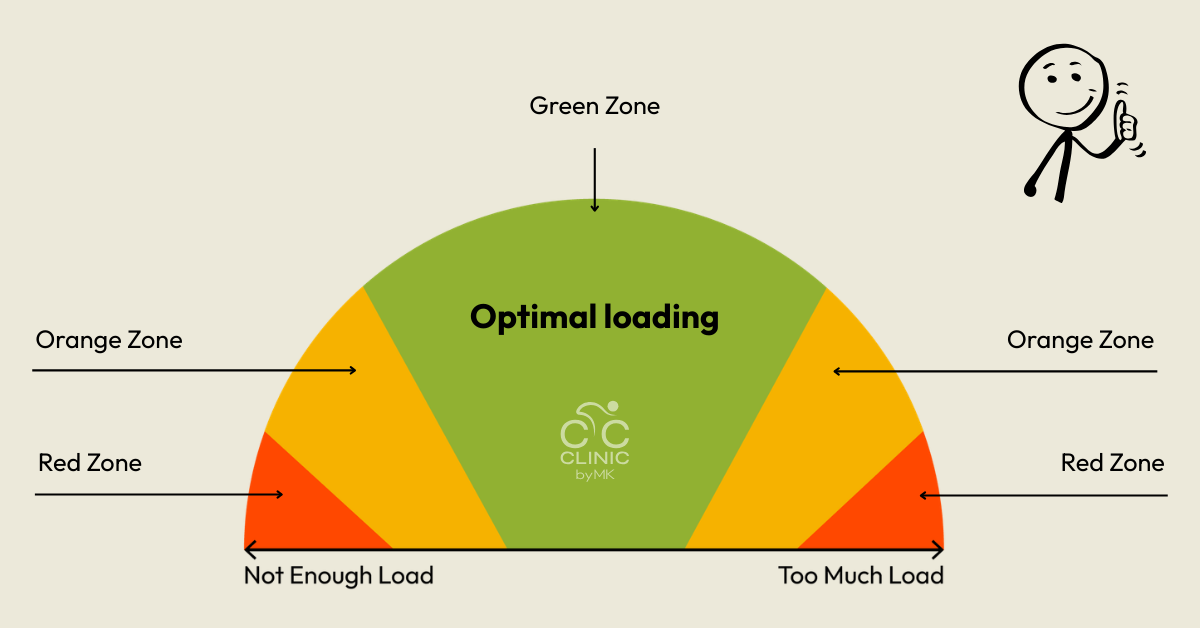
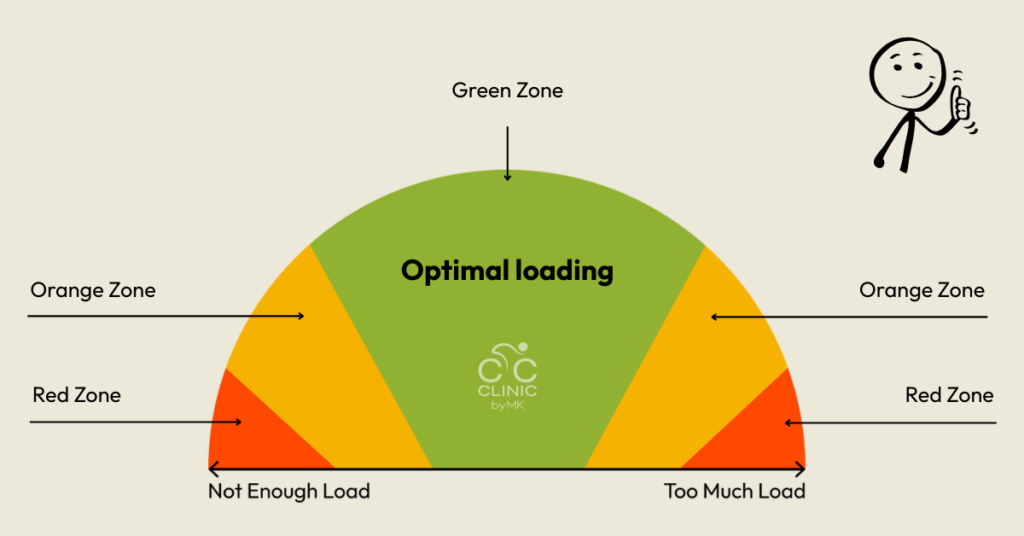
Inside the Green Zone, the body adapts and improves.
Outside the zone, the system begins to accumulate more stress than it can manage.
What Determines the Size of Your Green Zone?
The size of your Green Zone is not random.
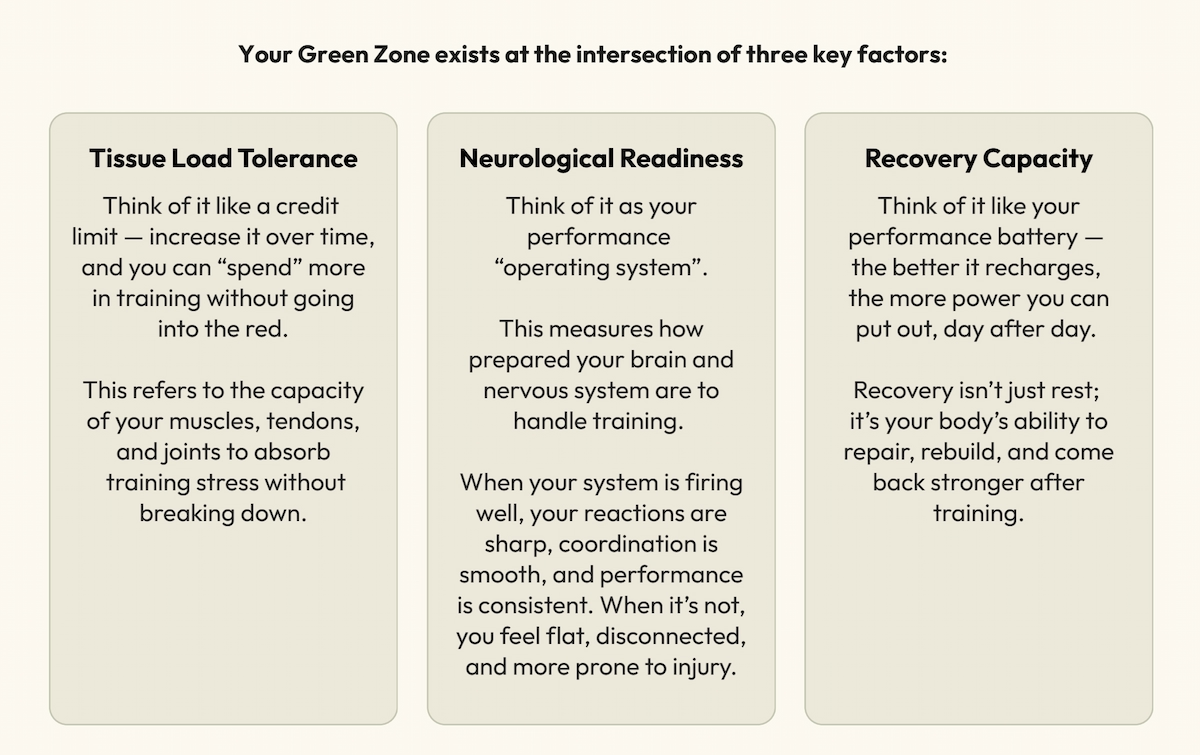
It depends on three key factors working together.
1. Neurological Readiness
Think of this as the operating system of your body.
Your nervous system controls:
- movement coordination
- muscle activation
- joint stability
When the nervous system is functioning well, movements remain controlled even under fatigue.
When readiness is reduced, movement patterns may start to break down.
For example:
A cyclist performing a single-leg squat may notice the knee drifting inward.
During thousands of pedal strokes, this same pattern may increase stress around the knee.
2. Tissue Load Tolerance
This represents how much mechanical stress your tissues can tolerate.
Muscles, tendons and connective tissue adapt over time when exposed to progressive loading.
Strength training plays a key role here.
Stronger tissues can tolerate higher forces without becoming irritated.
For example:
Two cyclists may climb the same hill at 300 watts.
The rider with greater tissue tolerance will often finish the climb comfortably.
The rider with lower tolerance may start to feel irritation around the knee.
3. Recovery Capacity
Recovery determines how quickly your body can restore itself after training.
This includes factors such as:
- sleep
- nutrition
- accumulated fatigue
- life stress
You can think of recovery capacity like a battery.
If the battery recharges well, the system can handle repeated training stress.
If recovery is limited, fatigue accumulates and the Green Zone becomes smaller.
What Happens When You Leave the Green Zone
When training stress repeatedly exceeds the capacity of the system, tissues start to experience irritation.
This does not usually happen overnight.
Most cycling injuries develop gradually.
At first a cyclist may only notice:
- stiffness after rides
- discomfort during longer climbs
- sensitivity around the knee
If training load continues to increase without improving system capacity, symptoms can progress to persistent pain.
Example: Climbing and Knee Pain
Climbing increases force production significantly compared to flat riding.
When cadence drops and torque increases, the knee joint experiences greater load.
If the system is well prepared, this stress is absorbed effectively.
If the system is close to its capacity limit, the additional load from climbing may push it outside the Green Zone.
This is why many cyclists first notice knee pain during:
- long climbs
- high-intensity intervals
- training camps with increased volume
How Cyclists Expand Their Green Zone
The good news is that the Green Zone is not fixed.
With the right training approach, cyclists can expand their capacity.
This allows them to tolerate higher training loads with less risk of injury.
Several strategies help expand the window:
Progressive strength training
Strength training increases the tolerance of muscles and connective tissue.
This improves how forces are distributed across the knee joint.
Improving movement control
Better hip and trunk stability often improves knee tracking during pedalling.
This reduces unnecessary stress around the joint.
Managing training load
Gradual increases in training volume allow tissues time to adapt.
*Sudden spikes in load are one of the most common reasons cyclists move outside the Green Zone.
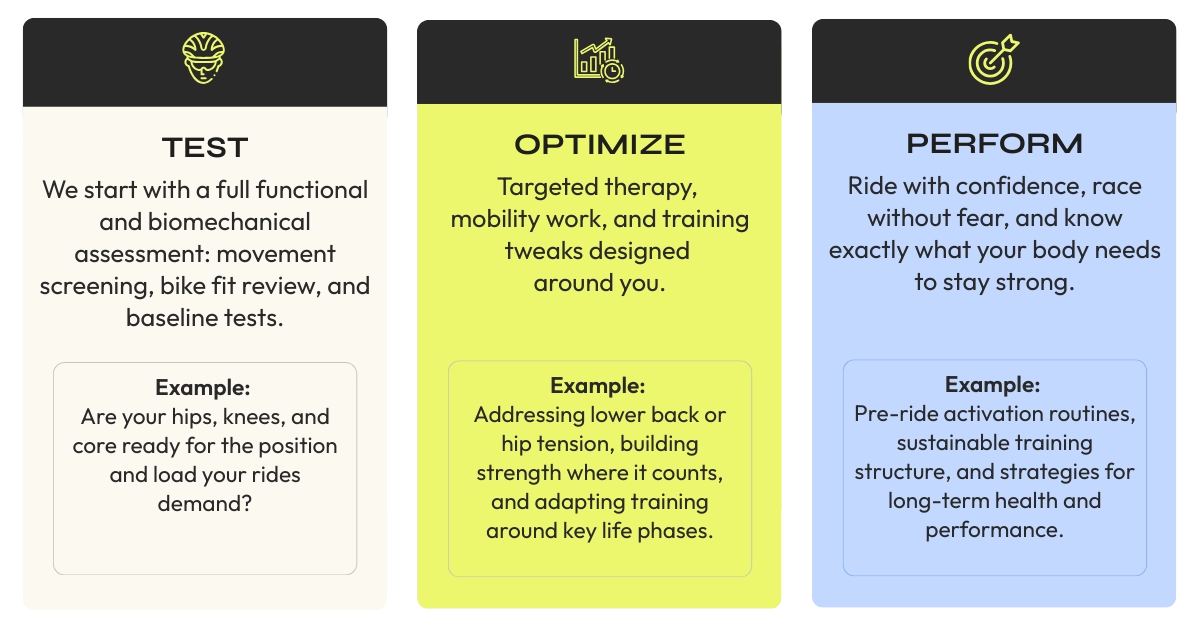
The Test → Optimise → Perform Framework
When working with cyclists experiencing knee pain, I often use a simple process.
Why This Matters for Cyclists
Many cyclists focus heavily on training load.
They increase hours, intensity and climbing volume.
But performance and injury prevention are closely connected.
If capacity does not grow alongside training load, the risk of injury increases.
Understanding your Green Zone helps you train hard enough to improve but not so hard that the system breaks down.
If you want to explore how your own body currently handles cycling load:
Download the Cycling Readiness Test Guide.
The guide walks through simple tests many cyclists can perform before their next training block.
If you want to understand the most common causes of cycling knee pain, read this guide:
Cycling Knee Pain: Causes, Tests and How Cyclists Can Fix It