Cycling is often considered a knee-friendly sport.
Yet knee pain is one of the most common problems cyclists experience, whether you ride recreationally on weekends or train seriously for events like gran fondos, stage races or long-distance triathlons.
Most cyclists assume the pain must come from the knee itself.
So they start adjusting their bike.
They change:
- saddle height
- cleat position
- saddle setback
Sometimes the pain improves for a while.
But very often it comes back again.
The reason is simple.
In many cases the problem is not the knee itself.
The problem is how the body handles load.
Recurring knee pain when cycling?
Start with a simple readiness check used with cyclists.
Why Cyclists Develop Knee Pain
Cycling places repetitive stress on the knee joint.
During a typical ride a cyclist performs approximately 4,000–6,000 pedal revolutions per hour.
During a long endurance ride this can easily exceed 20,000 knee movements.
If the system around the knee handles this load well, the body adapts and becomes stronger.
But if the system struggles to tolerate the load, irritation begins to develop.
Cyclists commonly experience knee pain when:
Training volume suddenly increases
For example:
A rider preparing for a gran fondo increases training from 6 hours per week to 12 hours per week.
The cardiovascular system adapts quickly.
But tendons, connective tissue and movement control take longer to adapt.
The result can be irritation around the knee.
Higher intensity efforts
Climbing long mountain passes, racing or doing interval sessions significantly increases the load placed on the knee.
A cyclist may feel completely comfortable during easy endurance rides, but develop knee pain during:
- sustained climbs
- threshold intervals
- long race efforts
Weak links in the system
The knee sits between the hip and the foot.
If the hip lacks stability or the foot and ankle cannot control load effectively, the knee often becomes the weakest link in the chain.
If you want to quickly check how your body currently handles load when cycling:
Start with a simple readiness check used with cyclists.
Why Bike Fit Alone Often Fails
Most cyclists first try to solve knee pain by adjusting their bike.
And bike fit does matter.
Correct saddle height, cleat position and saddle setback influence how forces travel through the body.
However bike adjustments only change how load is distributed.
They do not change how much load your body can tolerate.
For example:
A cyclist lowers their saddle slightly and the knee pain disappears.
But when training volume increases again, the pain returns.
This happens because the underlying issue is often capacity rather than position.
Understanding Cycling Injuries: Load vs Capacity
A useful way to understand cycling injuries is through the relationship between:
Load
and
Capacity
Load refers to the stress placed on the body.
In cycling this includes:
- training volume
- climbing intensity
- sprinting
- long rides
Capacity refers to the body’s ability to tolerate that load.
This includes:
- muscle strength
- tendon resilience
- movement control
- coordination
When load stays within the system’s capacity, the body adapts.
When load repeatedly exceeds capacity, tissues around the knee become irritated.
The Green-Zone Window
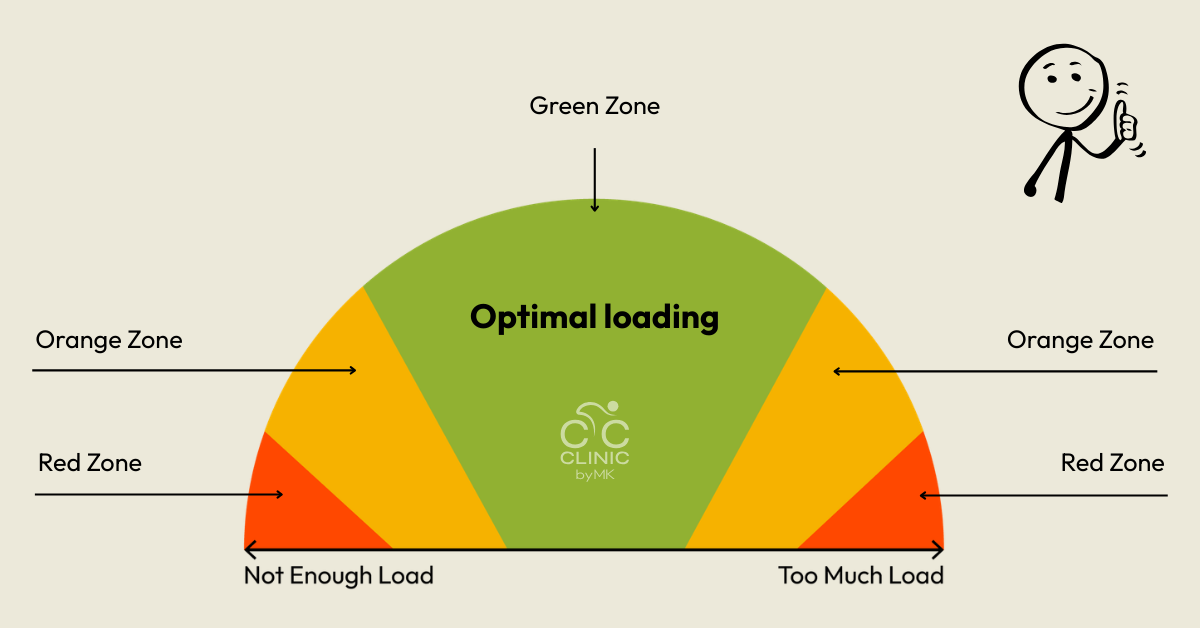
This relationship between load and capacity can be visualised using what I call the Green-Zone Window.
The Green Zone represents the range where training stress matches the body’s ability to:
- absorb load
- adapt
- recover
Inside the Green Zone, the body becomes stronger and more resilient.
Outside this zone, tissues become overloaded and symptoms may appear.
Example: Two Cyclists Riding the Same Climb
Imagine two cyclists riding the same alpine climb.
Both push 300 watts for 20 minutes.
Cyclist A finishes the climb comfortably.
Cyclist B develops knee pain halfway up.
The difference is rarely motivation.
It is usually capacity inside the Green-Zone Window.
Cyclist A has developed enough strength and tissue tolerance to stay inside the window.
Cyclist B exceeds the window and irritation begins to appear.
Want to see where your own
Green-Zone currently sits?
A Simple Readiness Test Cyclists Can Try
One of the easiest ways to assess how the system handles load is a single-leg squat test.
- Stand on one leg and slowly perform a squat.
- Watch what happens to the knee.
- Does the knee collapse inward?
- Does the hip drop on one side?
- Does one leg feel less stable?
- These patterns often reveal how well the body manages load.
- When similar patterns occur during thousands of pedal strokes, irritation can develop around the knee.
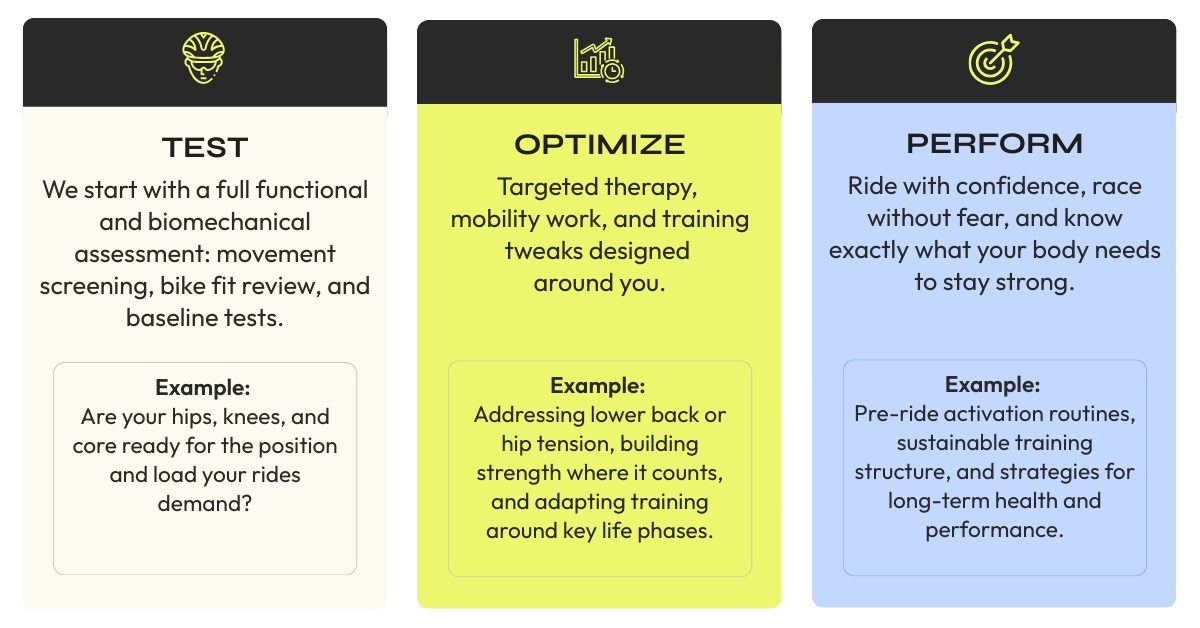
A Simple Framework: Test → Optimise → Perform
When working with cyclists experiencing knee pain, I often use a simple framework.
What Cyclists Should Do Next
If knee pain has been limiting your riding, the first step is understanding how your body currently handles load.
Small asymmetries often go unnoticed during riding but become obvious during simple readiness tests.
You can start by downloading the Cycling Readiness Test Guide.
This short guide walks you through several quick checks that many cyclists find helpful before their next training block.
Or join the upcoming Cycling Knee Pain Seminar, where we walk through these concepts step-by-step.